

Publications
2013
Compact RGBD Surface Models Based on Sparse Coding
by M. Ruhnke, L. Bo, D. Fox, and W. Burgard.
In: Proc.~of the National Conference on Artificial Intelligence (AAAI), 2013. To appear. [
Details].
Abstract:
In this paper, we describe a novel approach to construct compact colored
3D environment models representing local surface attributes via sparse
coding. Our method decomposes a set of colored point clouds into local
surface patches and encodes them based on an overcomplete dictionary.
Instead of storing the entire point cloud, we store a dictionary,
surface patch positions, and a sparse code description of the depth and
RGB attributes for every patch. The dictionary is learned in an
unsupervised way from surface patches sampled from indoor maps. We show
that better dictionaries can be learned by extending the K-SVD method
with a binary weighting scheme that ignores undefined surface cells.
Through experimental evaluation on real world laser and RGBD datasets
we demonstrate that our method produces compact and accurate models.
Furthermore, we clearly outperform an existing state of the art method
in terms of compactness, accuracy and computation time. Additionally,
we demonstrate that our sparse code descriptions can be utilized for
other important tasks including object detection.
BibTeX entry:
@inproceedings{ruhnke13aaai,
author = {Ruhnke, M. and Bo, Liefeng. and Fox, D. and Burgard, W.},
title = {Compact RGBD Surface Models Based on Sparse Coding},
booktitle = {Proc.~of the National Conference on Artificial Intelligence (AAAI)},
note = {To appear},
year = {2013}
}
A Navigation System for Robots Operating in Crowded Urban Environments.
by R. Kümmerle, M. Ruhnke, B. Steder, C. Stachniss, and W. Burgard.
In: Proc. of the IEEE Int. Conf. on Robotics & Automation (ICRA), 2013. To appear. [
Details].
Abstract:
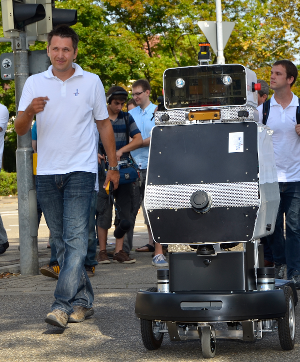
Over the past years, there has been a tremendous progress in the area of robot navigation. Most of the systems developed thus far, however, are restricted to indoor scenarios, non-urban outdoor environments, or road usage with cars. Urban areas introduce numerous challenges to autonomous mobile robots as they are highly complex and in addition to that dynamic. In this paper, we present a navigation system for pedestrian-like autonomous navigation with mobile robots in city environments. We describe different components including a SLAM system for dealing with huge maps of city centers, a planning approach for inferring feasible paths taking also into account the traversability and type of terrain, and a method for accurate localization in dynamic environments. The navigation system has been implemented and tested in several large-scale field tests in which the robot Obelix managed to autonomously navigate from our university campus over a 3.3 km long route to the city center of Freiburg.
BibTeX entry:
@inproceedings{kuemmerle13icra,
author = {K{\"u}mmerle, R. and Ruhnke, M. and Steder, B. and Stachniss, C. and Burgard,
W.},
title = {A Navigation System for Robots Operating in Crowded Urban Environments},
booktitle = {Proc.~of the IEEE Int.~Conf.~on Robotics and Automation (ICRA)},
note = {To appear},
year = {2013}
}
2012
Highly Accurate 3D Surface Models by Sparse Surface Adjustment.
by M. Ruhnke, R. Kümmerle, G. Grisetti and W. Burgard.
In: Proc. of the IEEE Int. Conf. on Robotics & Automation (ICRA), 2012. [
Details].
Abstract:
In this paper, we propose an approach to obtain highly accurate 3D
models from range data. The key idea of our method is to jointly
optimize the poses of the sensor and the positions of the surface
points measured with a range scanning device. Our approach applies a
physical model of the underlying range sensor. To solve the
optimization task it employs a state-of-the-art graph-based
optimizer and iteratively refines the structure of the error
function by recomputing the data associations after each
optimization. We present our approach and evaluate it on data
recorded in different real world environments with a RGBD camera
and a laser range scanner. The experimental results demonstrate
that our method is able to substantially improve the accuracy of
SLAM results and that it compares favorable over the moving
least squares method.
BibTeX entry:
@inproceedings{ruhnke12icra,
author = {Ruhnke, M. and K{\"u}mmerle, R. and Grisetti, G. and Burgard, W.},
title = {Highly Accurate 3D Surface Models by Sparse Surface Adjustment},
booktitle = {Proc.~of the IEEE Int.~Conf.~on Robotics \& Automation (ICRA)},
year = {2012}
}
3D Environment Modeling Based on Surface Primitives.
by M. Ruhnke, B. Steder,, G. Grisetti and W. Burgard.
In: Towards Service Robots for Everyday Environments, 2012. [
Details].
Abstract:
In this chapter we describe an algorithm for constructing a
compact representation of 3D laser range data. Our approach extracts
a dictionary of local scans from the scene. The words of this
dictionary are used to replace recurrent local 3D structures, which
leads to a substantial compression of the entire point cloud. We
optimize our model in terms of complexity and accuracy by minimizing
the Bayesian information criterion (BIC). Experimental evaluations
on large real-world datasets show that the described method allows robots to
accurately reconstruct environments with as few as 70 words.Furthermore
the experiments suggest that the proposed representation gives a richer
semantic description than pure occupancy based representations.
BibTeX entry:
@inbook{ruhnke20123d,
title={3D Environment Modeling Based on Surface Primitives},
author={Ruhnke, M. and Steder, B. and Grisetti, G. and Burgard, W.},
journal={Towards Service Robots for Everyday Environments},
pages={281--300},
year={2012},
publisher={Springer Berlin/Heidelberg}
}
2011
Range Sensor Based Model Construction by Sparse Surface Adjustment.
by M. Ruhnke, R. Kümmerle, G. Grisetti and W. Burgard.
In Proc. of the IEEE Workshop on Advanced Robotics and its Social Impacts (ARSO).
Half Moon Bay, CA, USA, October 2011. [
Details].
Abstract:
In this paper, we propose an approach to construct highly accurate 3D object models from range data. The main advantage of sensor based model acquisition compared to manual CAD model construction is the short time needed per object. The usual drawbacks of sensor based model reconstruction are sensor noise and errors in the sensor positions which typically lead to less accurate models. Our method drastically reduces this problem by applying a physical model of the underlying range sensor and utilizing a graph-based optimization technique. We present our approach and evaluate it on data recorded in different real world environments with an RGBD camera and a laser range scanner. The experimental results demonstrate that our method provides more accurate maps than standard SLAM methods and that it additionally compares favorable over the moving least squares method.
BibTeX entry:
@inproceedings{ruhnke11arso,
author = {Ruhnke, M. and K{\"u}mmerle, R. and Grisetti, G. and Burgard, W.},
title = {Range Sensor Based Model Construction by Sparse Surface Adjustment},
booktitle = {Proc. of the IEEE Workshop on Advanced Robotics and its Social Impacts (ARSO)},
address = {Half Moon Bay, CA, USA},
month = {October},
year = {2011}
}
Place Recognition in 3D Scans Using a Combination of Bag of Words and Point Feature based Relative Pose Estimation.
by B. Steder, M. Ruhnke, S. Grzonka, and W. Burgard.
In Proc. of the IEEE/RSJ International Conference on Intelligent Robots and Systems (IROS). 2011. [
Details].
Abstract:
Place recognition, i.e., the ability to recognize previously seen parts of the environment, is one of the fundamental tasks in mobile robotics. The wide range of applications of place recognition includes localization (determine the initial pose), SLAM (detect loop closures), and change detection in dynamic environments. In the past, only relatively little work has been carried out to attack this problem using 3D range data and the majority of approaches focuses on detecting similar structures without estimating relative poses. In this paper, we present an algorithm based on 3D range data that is able to reliably detect previously seen parts of the environment and at the same time calculates an accurate transformation between the corresponding scan-pairs. Our system uses the estimated transformation to evaluate a candidate and in this way to more robustly reject false positives for place recognition. We present an extensive set of experiments using publicly available datasets in which we compare our system to other state-of-the-art approaches.
BibTeX entry:
@inproceedings{steder11iros,
author = {Steder, B. and Ruhnke, M. and Grzonka, S. and Burgard, W.},
note = {Accepted for publication},
booktitle = {Proc.~of the IEEE/RSJ International Conference on Intelligent Robots and
Systems (IROS)},
year = {2011},
title = {Place Recognition in 3D Scans Using a Combination of Bag of Words and Point
Feature based Relative Pose Estimation}
}
Highly Accurate Maximum Likelihood Laser Mapping by Jointly Optimizing Laser Points and Robot Poses
by M. Ruhnke, R. Kümmerle, G. Grisetti, W. Burgard.
In: Proc. of the IEEE Int. Conf. on Robotics & Automation (ICRA), 2011. [
Details] [
Datasets]
Abstract:
In this paper we describe an algorithm for learning
highly accurate laser-based maps that treats the overall
mapping problem as a joint optimization problem over robot
poses and laser points. We assume that a laser range finder
senses points sampled from a regular surface and we utilize an
improved likelihood function that accounts for two phenomena
affecting the laser measurements that are often neglected: the
conic shape of the laser beam and the incidence angle. To solve
the entire problem we apply an optimization procedure that
jointly adjusts the position of all the robot poses and all points
in the scans. As a result, we obtain highly accurate maps. We
evaluated our approach using simulated and real-world data
and we show that utilizing the estimated maps greatly improves
the localization accuracy of robots. The results furthermore
demonstrate that the accuracy of the resulting map can exceed
the resolution of the laser sensors used.
BibTeX entry:
@inproceedings{ruhnke11icra,
author = {Ruhnke, M. and K{\"u}mmerle, R. and Grisetti, G. and Burgard, W},
booktitle = {Proc.~of the IEEE Int.~Conf.~on Robotics \& Automation (ICRA)},
year = {2011},
title = {Highly Accurate Maximum Likelihood Laser Mapping by Jointly Optimizing Laser Points and Robot Poses}
}
Datasets: Sparse Surface Adjustment 2D
We provide 2D SLAM solutions and the resulting optimized graphs
of the datasets used in our work. The software package to visualize and
reproduce the optimiation results can be found at
http://www.openslam.org.
We gratefully thank all the people that have made their datasets publicly
available on Radish: The Robotics Data Set Repository. These datasets are
available under the Creative Commons Attribution License.
Extract files befor usage!
Dataset: Freiburg Indoor Building 079
The raw log data was provided by Cyrill Stachniss.
SLAM Solution
SSA Solution
Dataset: Intel Research Lab (Seattle)
The raw log data was provided by Dirk Hähnel.
SLAM Solution
SSA Solution
Dataset: ACES Building (Austin)
The raw log data was provided by Patrick Beeson.
SLAM Solution
SSA Solution
Dataset: MIT CSAIL Building
The raw log data was provided by Cyrill Stachniss.
SLAM Solution
SSA Solution
2010
Unsupervised Learning of Compact 3D Models
Based on the Detection of Recurrent Structures
by M. Ruhnke, B. Steder, G. Grisetti, W. Burgard.
In: Proceedings of the IEEE/RSJ International Conference on Intelligent Robots and Systems (IROS), 2010. [
Details]
Abstract:
In this paper we describe a novel algorithm for
constructing a compact representation of 3D laser range data.
Our approach extracts an alphabet of local scans from the
scene. The words of this alphabet are used to replace recurrent
local 3D structures, which leads to a substantial compression
of the entire point cloud. We optimize our model in terms of
complexity and accuracy by minimizing the Bayesian information
criterion (BIC). Experimental evaluations on large realworld
data show that our method allows robots to accurately
reconstruct environments with as few as 70 words.
BibTeX entry:
@inproceedings{ruhnke10iros,
author = {Ruhnke, M. and Steder, B. and Grisetti, G. and Burgard, W},
title = {Unsupervised Learning of Compact 3D Models
Based on the Detection of Recurrent Structures},
booktitle = {Proc.~of the IEEE/RSJ International Conference on Intelligent
Robots and Systems (IROS)},
year = {2010},
address = {Taipei, Taiwan},
month= {October}
}
2009
On Measuring the Accuracy of SLAM Algorithms.
by R. Kümmerle, B. Steder, C. Dornhege, M. Ruhnke, G. Grisetti, C. Stachniss, and A. Kleiner.
Journal of Autonomous Robots, 2009. [
Details]
[
Evaluation Software and Datasets]
Abstract:
In this paper, we address the problem of creating an objective benchmark for evaluating SLAM approaches. We propose a framework for analyzing the results of a SLAM approach based on a metric for measuring the error of the corrected trajectory. This metric uses only relative relations between poses and does not rely on a global reference frame. This overcomes serious shortcomings of approaches using a global reference frame to compute the error. Our method furthermore allows us to compare SLAM approaches that use different estimation techniques or different sensor modalities since all computations are made based on the corrected trajectory of the robot. We provide sets of relative relations needed to compute our metric for an extensive set of datasets frequently used in the robotics community. The relations have been obtained by manually matching laser-range observations to avoid the errors caused by matching algorithms. Our benchmark framework allows the user to easily analyze and objectively compare different SLAM approaches.
BibTeX entry:
@article{kuemmerle09auro,
author = {K\"ummerle, R. and Steder, B. and Dornhege, C. and Ruhnke, M. and Grisetti, G.
and Stachniss, C. and Kleiner, A.},
doi = {http://dx.doi.org/10.1007/s10514-009-9155-6},
title = {On Measuring the Accuracy of {SLAM} Algorithms},
journal = {Journal of Autonomous Robots},
year = {2009}
}
A Comparison of SLAM Algorithms Based on a Graph of Relations
by W. Burgard and C. Stachniss and G. Grisetti and B. Steder and R. Kümmerle and C. Dornhege and
M. Ruhnke and A. Kleiner and Juan D. Tardós.
Proc. of the {IEEE/RSJ} Int. Conf. on Intelligent Robots and Systems (IROS) 2009 [
Details]
Abstract:
In this paper, we address the problem of creating an objective benchmark for comparing SLAM approaches. We propose a framework for analyzing the results of SLAM approaches based on a metric for measuring the error of the corrected trajectory. The metric uses only relative relations between poses and does not rely on a global reference frame. The idea is related to graph-based SLAM approaches in the sense that it considers the energy needed to deform the trajectory estimated by a SLAM approach to the ground truth trajectory. Our method enables us to compare SLAM approaches that use different estimation techniques or different sensor modalities since all computations are made based on the corrected trajectory of the robot. We provide sets of relative relations needed to compute our metric for an extensive set of datasets frequently used in the SLAM community. The relations have been obtained by manually matching laser-range observations. We believe that our benchmarking framework allows the user an easy analysis and objective comparisons between different SLAM approaches.
BibTeX entry:
@inproceedings{burgard09iros,
author = {W. Burgard and C. Stachniss and G. Grisetti and B. Steder and
R. K{\"u}mmerle and C. Dornhege and M. Ruhnke and A. Kleiner and
Juan D. Tard{\'o}s},
title = {A Comparison of SLAM Algorithms Based on a Graph of Relations},
booktitle = {Proc. of the {IEEE/RSJ} Int. Conf. on Intelligent Robots and Systems (IROS)},
address = {St. Louis, MO, USA},
month = oct,
year = {2009},
}
Unsupervised Learning of 3D Object Models from Partial Views
by M. Ruhnke, B. Steder, G. Grisetti, W. Burgard.
In Proc. of the IEEE Int. Conf. on Robotics & Automation (ICRA), Kobe, Japan, 2009. [
Details]
Abstract:
In this paper we present an algorithm for learning 3D object
models from partial object observations. The input to our
algorithm is a sequence of 3D laser range scans. Models learned
from the objects are represented as point clouds. Our approach
can deal with partial views and it can robustly learn accurate
models from complex scenes. It is based on an iterative match-
ing procedure which attempts to recursively merge similar
models. The alignment between models is determined using a
novel scan registration procedure based on range images. The
decision about which models to merge is performed by spectral
clustering of a similarity matrix whose entries represent the
consistency between different models.
BibTeX entry:
@inproceedings{ruhnke09icra,
author = {Ruhnke, M. and Steder, B. and Grisetti, G. and Burgard, W},
title = {Unsupervised Learning of 3D Object Models from Partial
Views},
year = {2009},
address = {Kobe, Japan},
booktitle= {Proc.~of the IEEE Int.~Conf.~on Robotics \& Automation
(ICRA)}
}
2008
Unüberwachtes Lernen von 3D Modellen für nicht stationäre Objekte auf volumetrischen Daten
by M. Ruhnke
Master Thesis, Albert-Ludwigs-Universität, Institut für Informatik, (Freiburg), 2008. In German. [
Details]
BibTeX entry:
@mastersthesis{ruhnke08thesis,
author = {M. Ruhnke},
title = {{U}n{\"u}berwachtes {L}ernen von 3D {M}odellen für nicht station{\"a}re {O}bjekte auf volumetrischen {D}aten},
school = {Albert-Ludwigs-Universit{\"a}t, Institut f{\"u}r Informatik},
address = {Freiburg},
year = {2008},
note = {In German},
url = {http://www.informatik.uni-freiburg.de/~ruhnke/papers/ruhnke-diplom-08.pdf}
}
2006
RoboCupRescue - Robot League Team RescueRobots Freiburg (Germany)
by A. Kleiner, C. Dornhege, R. Kümmerle, M. Ruhnke, B. Steder, B. Nebel, P. Doherty, M. Wzorek,
P. Rudol, G. Conte, S. Durante, and D. Lundstrom.
In RoboCup 2006 (CDROM Proceedings), Team Description Paper, Rescue Robot League, (Bremen, Germany), 2006. [
Details]
BibTeX entry:
@inproceedings{kleiner06robocup,
author = {A. Kleiner and C. Dornhege and R. K{\"u}mmerle and M. Ruhnke
and B. Steder and B. Nebel and P. Doherty and M. Wzorek and P.
Rudol and G. Conte and S. Durante and D. Lundstrom},
title = {{RoboCupRescue} - Robot League Team {RescueRobots Freiburg}
(Germany)},
booktitle = {RoboCup 2006 (CDROM Proceedings), Team Description Paper,
Rescue Robot League},
address = {Bremen, Germany},
year = {2006},
url = {http://www.informatik.uni-freiburg.de/~kuemmerl/papers/kleiner-et-al-tdp2006.pdf}
}